
Let’s be real—opening social media in 2026 can feel like stepping into a dumpster fire. Between climate anxiety, political chaos, and the never-ending hustle culture, the internet can be, as digital media professor Jessica Maddox perfectly put it a few years ago, “a pretty trash place.” But then, right when my soul is about to log off forever, my feed saves me with a golden retriever in pajamas, a cow named Crouton doing zoomies, or a diva pug refusing to get out of bed. And suddenly, the world doesn’t seem so bad.
I’ve been asking myself lately: How did animal content become the unofficial therapy of the internet? The answer goes way deeper than just awws and LOLs. In fact, over the past half-decade, researchers, pet parents, and millions of scrollers like me have turned to online pets not just for a quick hit of dopamine, but for genuine emotional support, metaphorical guidance, and even a sense of community. Let me take you on a little tour of the furry (and not so furry) friends who’ve been holding our mental health together since the pandemic—and why their power feels even stronger today.
From Isolation to Connection: How the Pandemic Sparked a Pet Content Revolution
Cast your mind back to 2020–2021. Lockdowns, social distancing, toilet paper shortages. The COVID-19 pandemic forced us into physical isolation, and suddenly we all craved digital connection more than ever. It’s no coincidence that during those years, pet accounts exploded. Professor Maddox, who literally wrote the book The Internet is for Cats, noted that the pandemic “accelerated a lot of what we did with pets and animals online.” We weren’t just mindlessly scrolling; we were reaching for a lifeline.
Take Rebecca Shore in Jacksonville, Florida. She fell head over heels for The Golden Ratio’s bunch of golden retrievers (and one honorary labradoodle) in 2020. She told me, “I watch the Daily Snaps every night as a wind-down because it’s such a positive, relaxing vibe.” And she’s not alone. For many of us, ending the day with a pack of happy dogs doing absolutely nothing but being adorable became a ritual—an emotional palate cleanser after hours of bad news.
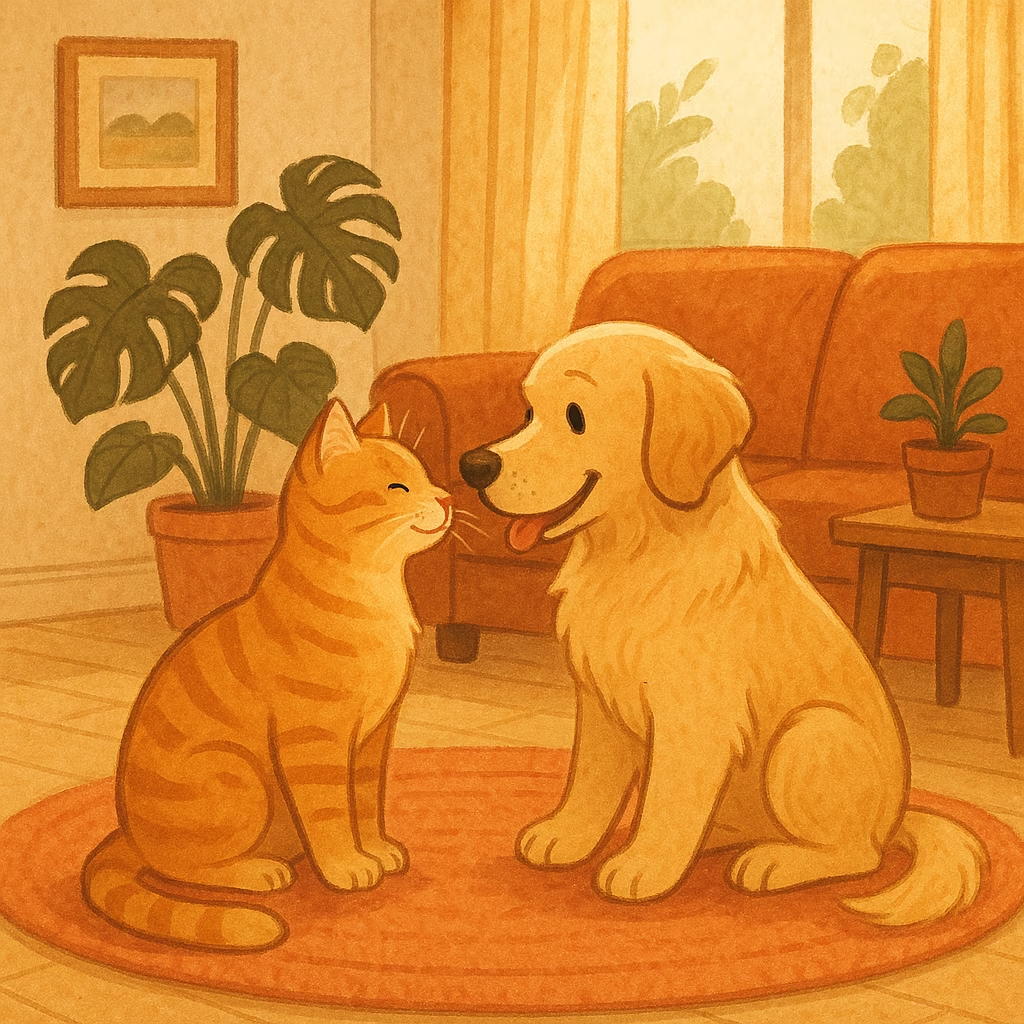
Then there’s Lorie Kinler in Texas, who found her nightlight in Crouton the cow. “During the pandemic they would post a video every evening called the Nightly Crouton,” she said. “I would watch it every night before I went to sleep. It made me smile and brought me so much joy during a difficult and scary time.” Crouton became more than a cow; she became a symbol of gentle normalcy when everything else felt upside down. Lorie even traveled to Squirrelwood Sanctuary to meet Crouton IRL—and yes, that magical meet-cute only deepened her love.
I bring up these stories because they illustrate something profound: Animal content on social media doesn’t just make us go “aww”; it creates optimistic feedback loops. Professor Maddox explained that sharing pet joy online shows “we’re willing to take care of each other. By sharing your joy and cuteness, this makes me happy, and then I want to share it with you because I think it will make you happy.” In 2026, that loop is still spinning—and it’s become a counterweight to the relentless negativity of the digital world. When I send my bestie a video of a sneezing baby hippo, I’m basically saying, “I see you’re struggling, I hope this tiny chaos nugget helps.” And it does.
The Metaphors That Keep Us Going: Fiona, Noodle, and the Power of Relatable Animals
Sometimes an internet animal isn’t just cute—they become a mirror for our own messy lives. Back in 2017, a premature hippo named Fiona captured the world’s heart. Born six weeks early at the Cincinnati Zoo, weighing just 28 pounds, her fight for survival became a beacon of hope. Alicia Mountain, a poet in Brooklyn, told me, “If this tiny fragile hippopotamus could survive in the world, so could I.” That metaphor was powerfully obvious yet deeply sustaining. Nancy Allen in Sacramento felt the same connection as her father faced a terminal cancer diagnosis: “Being able to celebrate her teeny tiny successes gave me something to be hopeful and joyful about.” Five years later—heck, even now in 2026—Fiona’s sassy mud rolls and underwater twirls still remind us that resilience comes in all sizes.
Fast-forward to 2021 and the internet crowned a new oracle: Noodle the Pug. If Fiona taught us to survive, Noodle taught us it’s okay not to thrive every single day. His famous “Bones or No Bones” videos, where his owner Jonathan Granziano would see if the elderly pug stood up in his bed, became a daily ritual for millions. A “Bones Day” meant go get ’em; a “No Bones Day” meant it’s fine to wrap yourself in a blanket and cancel plans. As Professor Maddox pointed out, Noodle arrived just when people were being summoned back to offices while still reeling from pandemic stress. His tiny flop became the ultimate validation: Yes, I also feel like a collapsed toy today, and that’s perfectly fine.
Even in 2026, “No Bones Day” has entered our permanent vocabulary. When my workday starts with three meeting cancellations and a spilled coffee, my group chat lights up with “Definitely a No Bones Day.” Noodle may have crossed the rainbow bridge (rest in peace, king), but his spirit lives on in every permission slip we give ourselves to rest.
Why Animal Content Still Hits Different in 2026
You might wonder: haven’t we moved on? Aren’t these trends from years ago? Absolutely not. In fact, the need for animal connection has only deepened. The post-pandemic world has brought new layers of burnout, return-to-office tension, and global uncertainties. A 2025 survey from the American Psychological Association found that 67% of young adults reported regularly watching animal videos to reduce stress—up from 55% in 2021. Social media platforms have responded too: TikTok’s algorithm practically shoves rescue-cat montages into my face before any negative news, and Instagram’s Explore page is basically a zoo curated by friends and strangers.
The landscape has evolved. While Noodle and Fiona remain icons, new stars have emerged. Take Mochi the Capybara, whose serene bath-time streams regularly trend on YouTube, or the duo of Pixel the parrot and Bruno the bulldog, whose unlikely friendship sparks joy every single day. And let’s not forget the ongoing rise of animal sanctuaries using live streaming to not only show cute animals but also educate about conservation—like the Elephant Nature Park in Thailand, whose baby elephant cams I confess to having on my second monitor during work (don’t tell my boss).
What’s wild is how these accounts have turned into true communities. In the comments under a skittish kitten’s first steps, you’ll find strangers cheering, sharing their own pet stories, and offering support. In a world that often pushes us apart, animals are pulling us together. I’ve made actual friends from fandom groups for internet-famous sheep. Yes, sheep. And honestly? No regrets.
The Secret Sauce: Animals Don’t Care About Your Productivity
I think the real magic is this: pets online exist outside human metrics. They don’t care about your to-do list, your deadlines, or your existential dread. Jonathan Granziano summed it up perfectly: dogs are “blissfully unaware of what’s going on, and there’s something comforting about that.” When I watch a bunny munch lettuce with zero awareness of stock market dips, I feel a weird sense of peace. The world becomes simpler, softer, and for a moment, I remember that joy doesn’t have to be earned.
Professor Maddox’s optimism sticks with me: animal content shows “we’re willing to take care of each other.” In 2026, that feels more radical than ever. So yeah, I’ll keep sharing golden retriever snaps, sending capybara memes to my coworkers, and saving cow videos for rough nights. This obsession isn’t silly—it’s survival. And if anyone asks why my camera roll is 90% other people’s pets, I’ll just say, “It’s a No Bones Day, and I choose joy.”
So here’s to the internet’s true heroes: the pugs, the hippos, the rescue cows, and every single furry, feathered, or scaly creature that reminds us to breathe. Keep the content coming. We need it more than ever.
Leave a Comment
Comments